




Specialized Adhesive Labels 8: The "Optical Shield" of Pharmaceutical Safety – Holographic Anti-Counterfeiting Labels
In the global battle against counterfeit goods, no battlefield is more critical—or more literal—than the pharmaceutical industry. Here, the stakes are not lost revenue or brand dilution, but human lives. The World Health Organization estimates that one in ten medical products circulating in low- and middle-income countries is substandard or falsified. These dangerous fakes can contain the wrong ingredients, incorrect dosages, or toxic substances, leading to treatment failure, drug resistance, and tragic fatalities. Protecting the pharmaceutical supply chain demands a multi-layered defense, and at the forefront of this effort, combining formidable optical complexity with digital intelligence, stands the Holographic Anti-Counterfeiting Label. It is not merely an identifier; it is an "optical shield" guarding the integrity of the medicines we trust.
The Dual Fronts of Pharmaceutical Counterfeiting
Pharmaceutical counterfeiting operates on two distinct fronts, each requiring a different defensive strategy:
-
The Visual Front (Patient & Pharmacist Level): The first line of defense is the ability of a patient, caregiver, or pharmacist to instantly recognize an authentic product. They need a simple, intuitive visual cue that a package is genuine. Sophisticated fakes can mimic bottle shapes and box colors, but replicating complex optical effects is exponentially harder.
-
The Forensic Front (Supply Chain & Regulatory Level): The deeper line of defense requires machine-readable, database-linked authentication. This allows regulatory bodies, customs officials, and distributors to trace a specific package's entire journey from the manufacturer to the pharmacy shelf, verifying its chain of custody.
Holographic anti-counterfeiting labels are uniquely positioned to address both fronts simultaneously, merging physical optical security with digital traceability.
The Engineering Solution: Light, Mathematics, and Information
Modern holographic labels are marvels of applied physics and precision manufacturing, far removed from the simple shiny stickers of the past.
1. The Optical Foundation: Laser Holography:
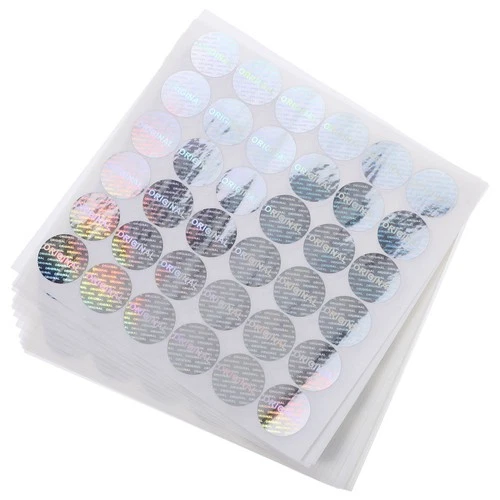
At the heart of the label is a laser-generated holographic image. Unlike a printed image, a hologram is created by recording the interference pattern of laser light. This results in a true three-dimensional image that changes appearance based on the viewing angle and light source. Key optical security features include:
-
2D/3D Holograms: Flat images with layered depth, creating a sense of dimension.
-
True 3D Holograms: Realistic, three-dimensional objects captured holographically.
-
Stereograms: Multiple images viewable from different angles, creating animation effects (e.g., a logo that "floats" or changes as the label is tilted).
-
Kinematic or Dot-Matrix Structures: Micro-diffractive patterns that create complex, moving light effects like shimmering waves or bursts.
-
Covert Laser Images (CLIs) or Microtext: Hidden images or text, often at the microscopic level, visible only under magnification or specific laser light.
2. The Material Matrix: Embedding Security into Film:
These optical effects are not printed but embossed onto a thin, high-quality film layer, often polyester. This film is then metallized (usually with aluminum) to enhance the brightness and reflectivity of the holographic image. For increased security, demetallization techniques can be used to selectively remove metal, creating intricate, transparent windows within the hologram—a feature almost impossible to replicate with standard printing.
3. The Digital Convergence: The "One Code, One Object" Imperative:
The true game-changer in pharmaceutical security has been the integration of holographic labels with digital traceability. This creates a hybrid solution that offers both instant visual verification and robust digital authentication. This is achieved through:
-
Personalized Variable Data: Each label is uniquely numbered and printed with a unique serial number and a corresponding 2D data matrix code or QR code.
-
Secure Database Integration: This unique code is registered in a secure, cloud-based database at the moment of label application. Patients and supply chain partners can scan the code with a smartphone to instantly verify the product's authenticity and view its complete traceability history.
-
Tamper-Evident Integration: The label can be designed with a destructible feature—a "VOID" pattern or a fragile base—so that any attempt to remove it from the package irreparably damages the holographic image and the code, providing clear evidence of tampering.
The Triple-Layer Defense: How It Protects the Patient
The combination of optical complexity and digital intelligence creates a formidable, multi-layered defense:
Layer 1: Instant Visual Authentication (Consumer Level):
The dynamic, shifting holographic image is immediately recognizable. A patient can quickly learn to look for this "optical signature" as the primary mark of authenticity. The sheer complexity of the hologram—the 3D depth, the micro-detail, the kinetic light effects—is prohibitively expensive and technically challenging for counterfeiters to replicate with any fidelity. They will typically produce a flat, printed imitation that fails the simplest visual inspection.
Layer 2: Digital Verification (Consumer & Stakeholder Level):
By scanning the QR or data matrix code with a smartphone, the patient is taken directly to the brand's secure verification portal. The code's authenticity is checked against the central database. A genuine code returns a confirmation and the product's details. A fake, copied, or invalid code triggers a warning, immediately alerting the user to potential danger. This also provides valuable data to the manufacturer about scanning locations, helping to identify hotspots of suspicious activity.
Layer 3: Full Lifecycle Traceability (Supply Chain Level):
At every step of the distribution chain—from manufacturer to wholesaler to hospital—the unique code on each package can be scanned. This creates an immutable digital record of the product's journey, ensuring chain of custody, enabling precise inventory management, and facilitating targeted recalls if necessary. This forensic-level data is invaluable for regulatory compliance and supply chain integrity.
Typical Application Case: Securing Premium Vaccines and Prescription Drugs
The Challenge: A leading multinational pharmaceutical company was facing a growing threat from counterfeiters targeting its portfolio of high-value vaccines and specialty prescription drugs. These sophisticated counterfeits were entering the supply chain in several regions, endangering patients and eroding trust in the brand. Standard, non-secure labels were easily copied. The company needed a solution that would be instantly verifiable by patients and healthcare providers, yet also provide deep, data-rich traceability throughout the global supply chain.
The Solution: The company implemented a comprehensive holographic anti-counterfeiting label system integrated with a secure cloud-based traceability platform.
How It Worked:
-
Label Design: Each label featured a complex, custom-designed 2D/3D hologram with the company's logo appearing to float above the background. Microtext with the batch number was hidden within the holographic pattern.
-
Digital Integration: The label was printed with a unique, randomized serial number and a 2D data matrix code. This code was linked in the central database to the product's GTIN, batch number, and expiry date.
-
Application & Activation: As each package was filled on the production line, the label was applied, and its unique code was scanned, "activating" it in the database as authentic and in circulation.
-
Consumer Engagement: The packaging clearly instructed users to "Scan to Verify." When scanned, the smartphone app displayed a simple "Authentic Product" confirmation, along with usage information and a link to the patient support program.
The Result: The impact was immediate and measurable:
-
Sharp Decline in Reported Counterfeits: The optical complexity of the hologram, combined with the digital verification layer, made the product an unattractive target. Reported incidents of suspected counterfeits dropped dramatically.
-
Empowered Patients and Providers: Patients and pharmacists gained a simple, reliable tool to verify the medicines they were using and dispensing. This built trust and loyalty.
-
Enhanced Supply Chain Visibility: The company gained unprecedented visibility into its distribution network. They could track the movement of individual packages, identify gray market diversion, and quickly isolate any suspicious activity.
-
Regulatory Compliance: The solution met and exceeded emerging global track-and-trace regulations, positioning the company as a leader in pharmaceutical security.
Conclusion: The Unbreakable Bond of Light and Data
In the pharmaceutical industry, a label's job is nothing less than to be a guardian of health. The holographic anti-counterfeiting label fulfills this role with a powerful synthesis of physics and information technology. Its optical complexity builds a barrier that counterfeiters cannot visually breach. Its digital intelligence builds a web of traceability they cannot data-ically penetrate.
This "optical shield" transforms the packaging from a simple container into a dynamic, verifiable, and interactive proof of authenticity. It gives patients confidence, provides supply chain partners with certainty, and arms manufacturers with a powerful weapon in the ongoing war against a deadly and deceptive trade. It is a testament to how specialized labeling, at its highest level, becomes an essential component of public safety.